
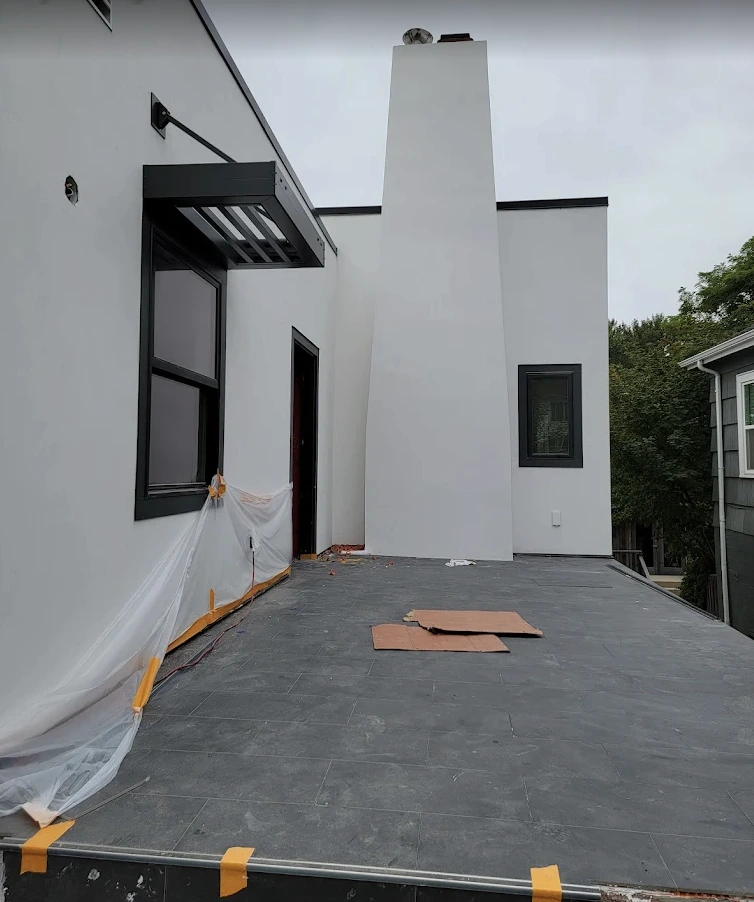
Drive through almost any Austin neighborhood and you will see stucco-look exteriors everywhere — a nod to the city's deep Spanish colonial architectural tradition. What is not obvious from the street is that some of those homes are clad in traditional cement stucco and others in EIFS, the synthetic alternative. The two look nearly identical, yet they behave very differently when it comes to insulation, durability, repair, and cost.
If you are building, renovating, or simply trying to maintain your home, understanding the difference helps you make better decisions and hire the right contractor. Here is an honest comparison.
What Is EIFS?
EIFS (Exterior Insulation and Finish System) is a multi-layer cladding system built around a foam insulation board. Over the foam, a polymer base coat with embedded fiberglass mesh provides strength, and an acrylic finish coat provides the textured, colored surface. Because it looks like stucco, it is often called "synthetic stucco." For a full breakdown of the layers and history, see our guide to what EIFS is.
What Is Traditional Stucco?
Traditional stucco is a cement-based plaster applied directly over a substrate. The classic approach is a **three-coat system**: a scratch coat, a brown coat, and a finish coat, all applied over metal lath fastened to the wall (or directly over masonry). A faster **one-coat system** combines functions into fewer layers. Either way, the result is a hard, dense, monolithic cement skin. The color can be integrated into the finish coat or applied as paint afterward.
Side-by-Side Comparison
| Feature | EIFS (Synthetic Stucco) | Traditional Stucco |
|---|---|---|
| Insulation | Continuous EPS foam board — high R-value | No built-in insulation |
| Weight | Lightweight | Heavier (cement-based) |
| Energy efficiency | Significantly better | Standard |
| Flexibility | More flexible, handles movement | More rigid, more prone to cracking |
| Repairability | Requires EIFS-qualified contractor | Most stucco contractors can repair |
| Appearance | Nearly identical finish options | Traditional look |
| Cost (new install) | Moderate to high | Moderate |
| Lifespan (maintained) | 30–50+ years | 50+ years |
| Best for | Energy-conscious builds, commercial, retrofit | Historic properties, masonry over |
A few rows deserve extra context. The **insulation** difference is the headline advantage of EIFS — that continuous foam layer reduces thermal bridging in a way cement stucco simply cannot match. **Flexibility** matters in Texas because expansive clay soils move foundations; the flexible EIFS finish tolerates that movement better, while rigid cement stucco is more prone to cracking. On the other hand, **repairability** favors traditional stucco for everyday homeowners, since more contractors can patch cement than can correctly repair a layered EIFS assembly. And while both systems last decades, properly applied cement stucco edges out EIFS on raw **lifespan**.
Which System Is More Common in Austin?
Both are extremely common in Austin, thanks to the region's Spanish colonial and Mediterranean architectural heritage, which has favored stucco-style exteriors for generations. Traditional cement stucco dominates older homes and historic districts. EIFS became especially popular for commercial buildings, retail centers, and newer subdivisions during the 1990s and 2000s, when its energy efficiency and design flexibility made it attractive for large projects. Today you will find both throughout the metro, often on neighboring streets.
Cost Comparison
For a typical home, traditional three-coat stucco installation in the Texas market generally runs in the moderate range, with pricing driven by wall area, the number of coats, and finish complexity. EIFS installation tends to land in the moderate-to-high range because of the added insulation board and the specialized labor required to install the system to manufacturer specification. The gap narrows when you factor in energy savings: the continuous insulation in EIFS can reduce cooling bills year after year in the Austin heat, which offsets some of the higher upfront cost over time. For an accurate number on your specific project, a free EIFS estimate is the best starting point.
Which System Is Easier to Repair?
Traditional stucco repair is more accessible. Cement patching, crack filling, and texture matching can be performed by most experienced stucco contractors, and small repairs are even within reach of a capable DIYer. EIFS repair is a different story. Because EIFS is a layered, manufacturer-specific system, repairs must match the base coat, mesh, and finish, and they must restore the system's moisture management. Done wrong, an EIFS patch can trap water and cause hidden damage. That is why EIFS repair should always go to a qualified EIFS contractor — see our overview of the EIFS repair process in Austin.
Which Performs Better in the Austin Climate?
Both systems perform well in Central Texas when installed correctly. EIFS holds the clear advantage in **energy efficiency**, thanks to its continuous insulation, and its flexibility helps it handle the thermal cycling and soil movement common to the area. Traditional stucco holds the advantage in **longevity and impact resistance** — a hard cement surface shrugs off impacts that would dent EIFS, and a well-applied cement system can last well over 50 years. The right choice depends on whether you prioritize energy performance and design flexibility (EIFS) or maximum durability and a traditional cement surface (stucco).
Can You Convert EIFS to Traditional Stucco or Vice Versa?
Yes. Converting from one system to the other is possible, but it requires full removal of the existing cladding down to the substrate and a complete reinstallation of the new system. This is most commonly done when an older barrier-style EIFS has suffered significant moisture damage and a homeowner wants to switch to cement stucco — or, conversely, when an owner wants to add the insulation benefits of EIFS to a home currently clad in cement. Because conversion involves stripping the wall and inspecting the substrate, it is a project for an experienced contractor.
Closing
There is no single "best" answer — the right system depends on your priorities, your budget, and your building. What matters most is correct installation and the right contractor for whichever system you choose. If you would like an expert assessment of your home, Star Stucco of Austin can help. As your local EIFS contractor and full-service Austin stucco contractor, we offer free consultations and system assessments throughout the Austin area. Reach out for a free estimate and we will help you choose with confidence.